
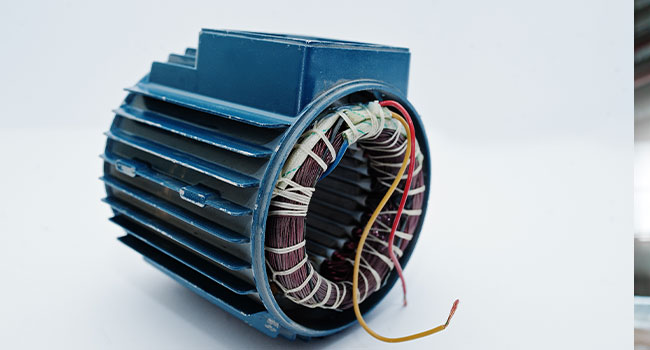
When an electric motor develops a winding fault, one of the first questions that comes up is whether it can be rewound. Rewinding is one of the most common and cost-effective motor repair procedures — but it’s also one of the most misunderstood.
Some facility managers assume rewinding is a last resort. Others assume any motor can be rewound and restored to perfect condition. The truth sits somewhere in between, and understanding it will help you make a much better decision when the time comes.
What Is Motor Rewinding, Exactly?
When a motor runs, electrical current passes through copper windings inside the stator. These windings are coated in insulation material that keeps the electrical current flowing correctly and prevents short circuits. Over time — especially in harsh environments like Abu Dhabi’s industrial facilities — this insulation breaks down due to heat, moisture, contamination, or electrical stress.
When the insulation fails, you get winding faults: short circuits between turns, phase-to-phase faults, or complete winding burnout. In these cases, the motor either stops working entirely or runs poorly and overheats.
Motor rewinding involves removing the damaged windings from the stator, cleaning and inspecting the core, and installing fresh copper windings with new insulation — wound to the exact same specification as the original. Done correctly, a rewound motor performs to the same standard as a new one.
When Is Rewinding the Right Option?
Rewinding makes sense in several situations:
- The motor has a winding fault but the core and mechanical components are in good condition. If the stator core is undamaged and the rotor, bearings, and shaft are serviceable, rewinding is almost always more cost-effective than replacement.
- The motor has a non-standard specification. Some industrial motors — particularly older or custom-built units — are difficult or expensive to source as replacements. Rewinding keeps the existing motor in service without the procurement headache.
- The motor is relatively young. A motor that’s five or eight years old with a winding fault due to a specific incident (a voltage surge, a cooling failure) is a strong candidate for rewinding.
- Replacement lead times are too long. In Abu Dhabi, sourcing certain HV or specialised motors can take weeks. A rewind carried out by an experienced workshop can often be completed faster.
When Rewinding Won’t Solve the Problem
This is the part that doesn’t get talked about enough. Rewinding is not always the right answer, and a trustworthy repair specialist will tell you so.
If the stator core has suffered heat damage — a condition called core burn — the iron laminations lose their magnetic properties and the motor will never run efficiently again, regardless of how well the rewind is done. Core damage needs to be identified through proper testing before any rewinding work begins.
Similarly, if the motor has reached the end of its service life and has multiple deteriorating components beyond just the windings, a rewind might restore electrical function but leave you with a motor that fails again shortly after for a different reason.
A proper incoming inspection and core loss test before any rewinding work starts is non-negotiable. If a repair company skips this step, that’s a red flag.
What the Rewinding Process Actually Involves
A quality rewind carried out by experienced technicians follows a structured process:
Incoming inspection. The motor is assessed before any work begins — measurements recorded, fault identified, core condition checked.
Strip and clean. The damaged windings are carefully removed. The stator core is cleaned and inspected for damage.
Core loss test. This test verifies the condition of the stator core and confirms whether rewinding is viable.
Winding. New copper windings are wound to the original specification — same wire gauge, same number of turns, same coil pitch. This is where skill and accuracy matter most.
Insulation and impregnation. The new windings are insulated and the entire stator is vacuum-impregnated with varnish to protect against moisture and contamination — especially important in Abu Dhabi’s environment.
Testing. Before the motor is reassembled, the rewound stator is tested for insulation resistance, winding resistance balance, and high voltage withstand.
Final assembly and test run. The motor is reassembled, aligned, and run under load to verify performance before it’s returned to the client.
What to Expect on Cost and Turnaround
A rewind is almost always significantly cheaper than purchasing a new equivalent motor — often 30 to 60 percent of the replacement cost, depending on the motor size and type. Turnaround time in a well-equipped workshop typically ranges from a few days for smaller LV motors to one to two weeks for larger or HV units.
The key variable is the workshop’s capacity and experience. A rewind carried out in a properly equipped facility with experienced winding technicians will be faster and more reliable than one done by a contractor who handles it occasionally.
Motor rewinding is a well-established, proven repair technique that — when carried out correctly — restores a motor to full performance at a fraction of the replacement cost. The decision to rewind should always be based on a proper assessment of the motor’s condition, not just the winding fault in isolation.
If you’re dealing with a winding fault and aren’t sure whether rewinding is the right call, the first step is getting an honest evaluation from a specialist with the equipment and experience to assess the motor properly.
Deluxe Energy Solutions provides motor rewinding and repair services in Abu Dhabi for LV and HV motors across all industries. Contact us to arrange an assessment.