
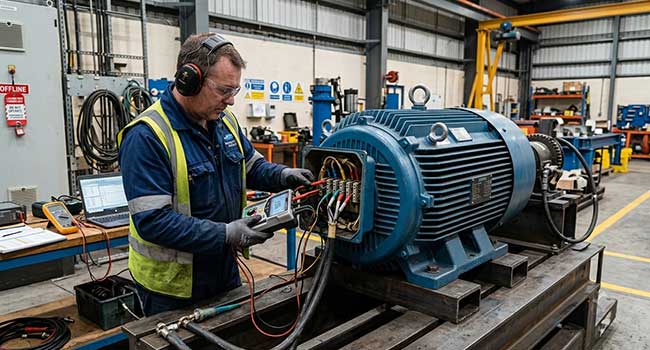
Most motor failures don’t announce themselves. They develop quietly over weeks or months — insulation degrading a little more each day, a bearing wearing gradually, a winding fault growing until it finally causes a complete breakdown at the worst possible moment.
The good news is that most of these developing faults can be detected long before they cause a failure. Motor offline testing is one of the most reliable ways to do that , and it’s one of the most underused tools in industrial maintenance in Abu Dhabi.
What Is Motor Offline Testing?
Offline testing means assessing a motor while it is de-energised and not running. The motor is disconnected from its power supply, and a range of electrical tests are performed on the windings, insulation, and other components to evaluate their condition.
This is different from running the motor and observing how it performs. Offline testing gives you direct measurements of the motor’s electrical health , numbers that tell you the actual condition of the insulation and windings, not just whether the motor is currently able to turn.
The key tests carried out during a motor offline assessment include:
Insulation Resistance (IR) Test. A DC voltage is applied between the motor windings and the frame to measure how effectively the insulation is resisting electrical leakage. A healthy motor has high insulation resistance. A declining reading over time is one of the earliest indicators of insulation deterioration.
Polarisation Index (PI) Test. This extends the insulation resistance test over a ten-minute period and compares the reading at one minute to the reading at ten minutes. The ratio between the two gives an indication of insulation quality and moisture contamination. A low polarisation index suggests the insulation is absorbing moisture or is significantly degraded.
Winding Resistance Test. This measures the DC resistance of each winding phase and compares them to each other. An imbalance between phases can indicate a developing fault in one winding , a partial short circuit or a connection problem that wouldn’t be obvious from the outside.
High Voltage Withstand Test (Hipot). This applies a higher voltage than normal operating voltage across the insulation to verify it can withstand electrical stress without breaking down. It’s typically used after a repair or rewind to confirm the insulation is sound before the motor goes back into service.
Surge Comparison Test. This test identifies turn-to-turn shorts within a winding , faults that insulation resistance testing alone may not reveal. It applies high-frequency voltage pulses to each winding and compares the waveforms. A healthy motor shows identical waveforms across all phases.
What Offline Testing Can Find That Visual Inspection Cannot
A motor can look perfectly fine on the outside while serious faults are developing internally. Visual inspection tells you about surface damage, contamination, and obvious mechanical issues. It tells you nothing about the condition of the insulation deep within the windings.
Offline testing routinely detects:
- Early-stage insulation degradation before it causes a winding fault
- Moisture ingress into the windings , a common problem in Abu Dhabi’s coastal and humid industrial areas
- Partial winding shorts that cause localised overheating
- Phase imbalances that put uneven stress on the motor and its connected supply
- Post-repair winding issues that need to be addressed before the motor returns to service
Catching any of these conditions early means the intervention is small , a drying-out treatment, a resin impregnation, or a targeted repair. Missing them until they cause a failure means a full breakdown, unplanned downtime, and a significantly more expensive repair.
Which Industries in Abu Dhabi Benefit Most From Scheduled Offline Testing?
The honest answer is any industry that relies on motors for critical processes. But in practice, offline testing programmes deliver the most value in:
Oil, gas, and petrochemical facilities, where motor failures can shut down entire process trains and create safety risks.
Water treatment and desalination plants, where pump motors run continuously and downtime directly affects water supply.
Manufacturing and food processing facilities, where production continuity is directly tied to motor reliability.
Hospitals and data centres, where any equipment failure has immediate operational and safety consequences.
Port and logistics operations, where crane and conveyor motors operate under sustained heavy load.
If your facility has motors in any of these categories that haven’t been tested in the last 12 months, that’s a gap worth closing.
How to Schedule Offline Testing Without Disrupting Operations
One of the most common reasons facilities delay motor testing is the concern about taking equipment offline. In most cases, this concern is manageable with proper planning.
Offline testing of a single motor typically takes between one and three hours depending on the size and the test scope. For facilities running continuous processes, testing can often be scheduled during planned maintenance windows, shift changeovers, or periods of lower production demand.
At Deluxe Energy Solutions, we work with clients to schedule offline testing around their operational requirements — minimising disruption while ensuring the assessment covers everything it needs to. We provide a written test report with all measurements recorded, trended against previous results where available, and recommendations clearly stated.
Motor offline testing is not a complicated or disruptive process. It’s a straightforward set of electrical measurements that gives you objective data on your motor’s condition — data that allows you to plan maintenance, schedule repairs, and avoid unplanned failures.
In Abu Dhabi’s industrial environment, where motors work hard in demanding conditions, offline testing is one of the most cost-effective investments a maintenance programme can include.
Deluxe Energy Solutions provides motor offline testing services across Abu Dhabi for LV and HV motors. Contact us to arrange a testing programme for your facility.