
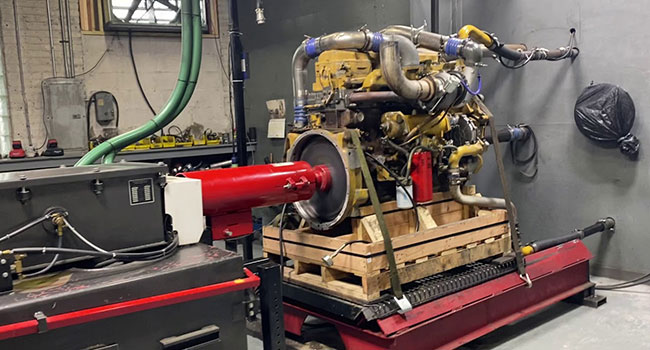
After a major engine repair or overhaul, one question should always be asked before the engine goes back into service: how do we know it is actually performing to specification? At Deluxe Energy Solutions, we have been carrying out diesel engine dynamometer testing in Abu Dhabi for over 25 years. In that time, we have seen what happens when engines return to service without proper performance verification – and it is rarely a good outcome. This guide explains what dyno testing is, what the data reveals, and why it is a non-negotiable step after any significant diesel engine repair.
What Is a Dynamometer Test?
A dynamometer – commonly called a dyno , is a piece of equipment that applies a controlled, measurable load to an engine and records its performance under that load. Unlike running an engine at idle or light load in a workshop, a dyno test puts the engine under real demand and measures exactly how it responds.
The key parameters recorded during a diesel engine dyno test include:
- Power output — the actual kilowatts or horsepower the engine produces at various speeds
- Torque — the rotational force the engine delivers across its operating range
- Fuel consumption — how efficiently the engine converts fuel into usable power
- Exhaust temperature — an indicator of combustion quality and turbocharger condition
- Oil pressure and coolant temperature — confirming the engine’s systems are within safe limits under sustained load
When these figures are compared against the engine’s original factory specification, you get an objective, documented picture of whether the repair has restored performance to where it should be , or whether something still needs attention.
Why a Workshop Run Test Is Not Enough
After an overhaul, it is common practice to start the engine, let it warm up, and run it briefly at light load to check for obvious leaks or unusual noise. This is a useful first check, but it is not a performance verification.
An engine can start smoothly, idle quietly, and show normal readings at light load — and still fail to deliver its rated power output when put under real demand. Fuel delivery problems, turbocharger inefficiencies, compression variation between cylinders, and governor calibration errors all tend to show up under load, not at idle.
A dyno test eliminates this uncertainty. It is the only way to confirm, with documented data, that an overhauled engine is performing to specification before it returns to service.
When Dyno Testing Is the Right Call
After a major overhaul. Any engine that has undergone comprehensive work — cylinder head reconditioning, piston and liner replacement, fuel system overhaul — should be dyno tested before returning to service. The overhaul involves many interdependent components, and dyno testing confirms they are all working together correctly under load.
After significant repair work. Engine repairs that affect power delivery — injector replacement, turbocharger work, fuel pump reconditioning, or governor adjustment — warrant a dyno test to verify the repair has achieved the intended result.
For insurance and compliance documentation. Many facilities in Abu Dhabi, particularly in oil and gas, power generation, and critical infrastructure, require documented engine performance data for insurance submissions or regulatory compliance. A dyno test report provides exactly that — objective data, not an engineer’s verbal assurance.
Before commissioning a rebuilt engine. If a rebuilt engine is being installed in a new application, a dyno test confirms it is fit for the specific duty before installation. Finding a performance problem on the dyno is far simpler than diagnosing one after the engine is installed and connected.
When performance decline is suspected. If an engine in service is consuming more fuel than usual, struggling under normal load, or showing reduced output, a dyno test provides objective data to identify whether the issue is with the engine itself or an external factor.
Deluxe Energy Solutions’ Dyno Capability in Abu Dhabi
At our Musaffah workshop, Deluxe Energy Solutions operates a 2500HP dynamometer facility — one of the most capable diesel engine testing setups available in Abu Dhabi. This allows us to test a wide range of engine sizes, from smaller generator engines to the large industrial diesel engines used in oil and gas, construction, and power generation across the UAE.
Every dyno test at our facility produces a detailed written report covering all performance parameters at multiple load points, compared against original factory specification. The report clearly identifies any area where performance falls short, what is causing it, and what the recommended next step is.
Our technicians discuss findings with clients in plain terms. If the dyno test reveals a remaining issue, we explain what it is and what fixing it involves before any further work is authorised. No surprises, no unexplained recommendations.
A diesel engine that starts and runs at light load is not a verified engine. True performance verification means testing under controlled, measurable load conditions that replicate real operating demand — and that is exactly what a dyno test delivers.
For Abu Dhabi industrial facilities where engine and generator reliability is critical, dyno testing after a major repair or overhaul is not an optional extra. It is the step that confirms your repair investment has actually achieved what it was supposed to.
Call or WhatsApp Deluxe Energy Solutions to book diesel engine dyno testing at our Musaffah facility in Abu Dhabi. Documented results, expert analysis, and honest recommendations from a team with 25+ years of UAE experience.