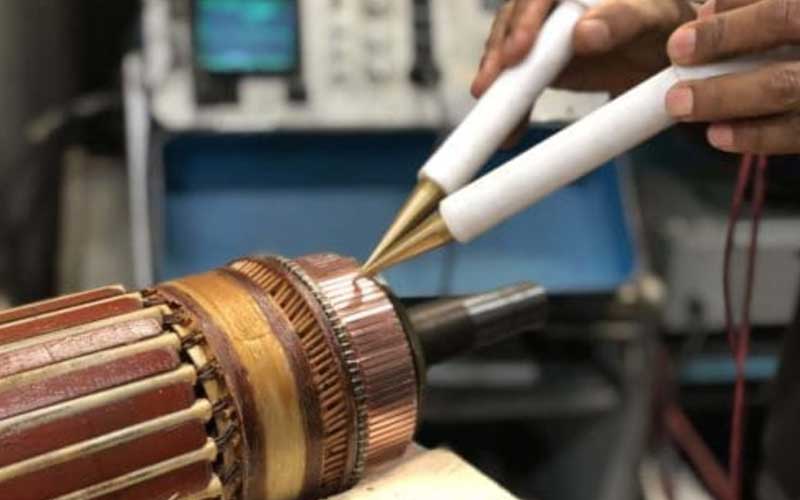
The Motor Online Test incorporates various sophisticated analyses ensuring optimal motor functionality while the machinery is in operation
3-Phase Electrical Signature Analysis
This process involves collecting motor current and voltage patterns at a fixed load using a high-resolution data collector, often coupled with vibration spectrum analysis. Employing time-based assessments, FFT, and frequency peak detection, algorithms detect conditions such as static/dynamic eccentricity, soft foot issues, or bearing defects caused by electric currents. For slip-ring motors, identification of rotor asymmetry is possible. Additionally, it analyzes line parameters like harmonics, current/voltage imbalances, and efficiency.
Acoustic Emission
Using ISO 22096:2007 standards, this test identifies bearing defects such as spalling in roller balls or inner/outer raceways. The severity of these defects is determined, and an action plan is recommended. Acoustic emissions, employing the “Shock-pulse” technique, effectively capture such defects caused by spalling, aiding in comprehensive defect detection and action planning.
Vibration Measurement and Spectrum Analysis
Following ISO standards, motor vibrations are measured during operation using a tri-axial accelerometer and a vibration analyzer. Employing high-resolution analysis, this process assesses rotor balancing, alignment with external loads (gearbox, compressor, pump, fan), eccentricity, soft foot problems, and bearing defects. Equipment like the Crystal Coco-80 Vibration Analyzer or SPM Diamond Analyzer ensures thorough analysis through time-based studies and frequency peak detection.