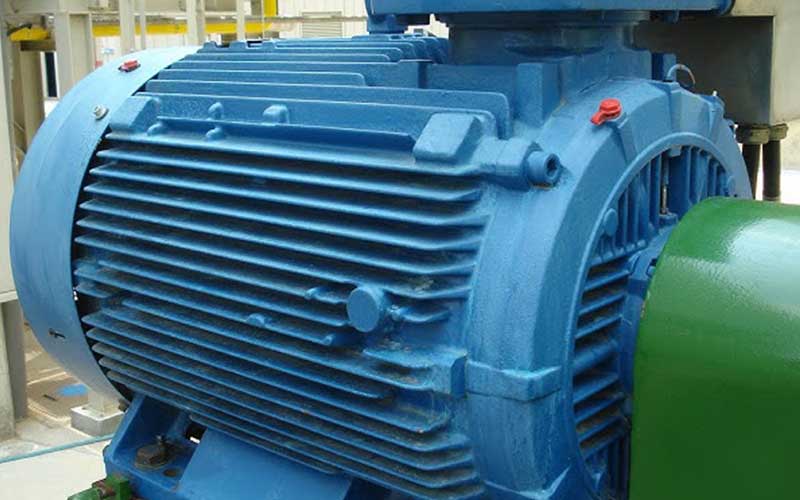
The Motor Offline Test involves several sophisticated procedures to assess and maintain the health of stator windings, ensuring optimal performance and longevity of motors. Here’s an overview:
Digital EL-CID Test on Stator Core
This test improves upon conventional core flux testing by applying 4% flux instead of 100%, making it more practical for large generators. By measuring voltage generated in a flux sensor moved along the core periphery, it detects laminar shorting, revealing defects as variations in measured waveforms.
Insulation Profiling by Charge-Discharge Method
This method, based on IEEE standards, evaluates insulation resistance (IR) values and the Polarization Index (PI) for assessing insulation dryness or wetness. For modern insulation types like Class F, IR values remain high due to minimal moisture penetration, requiring additional parameters for evaluation.
Insulation Leakage Spectral Analysis
Studies on leakage currents in insulators indicate an increase in odd harmonics (3, 5, 7, 9) with contamination or aging. For stator insulation with non-linear materials, this analysis uses FFT spectra to detect partial discharges and assess insulation conditions.
Tan Delta and Capacitance Analysis
Following CIGRE 552 & IEEE 286, this test examines insulation health, focusing on stator coils. It evaluates variations in tan delta and capacitance curves to detect resin cure, delamination, moisture presence, and dielectric loss.
Phase Resolved Partial Discharge Analysis
Adhering to IEEE 1434 and IEC standards, this test detects PD inception/extinction voltages, providing insights into insulation conditions. It uses PD signals at various frequencies for accurate analysis and maintenance guidance.
Motor Circuit Analysis
Primarily for LT motors, this test checks inductance, capacitance, and phase angles, aiding in troubleshooting issues like interturn faults, cable faults, or phase unbalance.
DC Winding Resistance
This test measures the balance in three phases using a micro-ohmmeter, post-rewinding or for trend analysis to detect developing high resistive joints.
Surge Comparison Test
Following IEEE 522, this test assesses inter-turn insulation health by measuring repetitive voltage surges and comparing their characteristics among different phases, revealing shorted turns or developing interturn faults.