
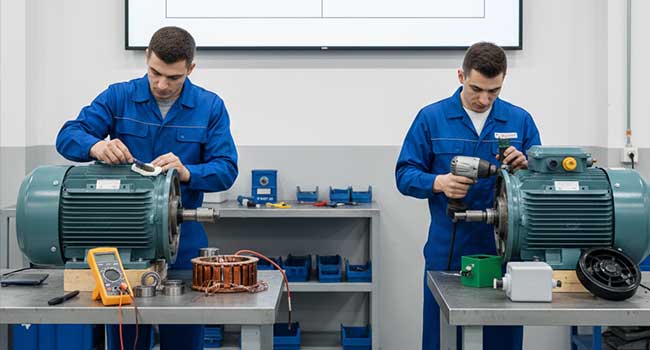
Motor Repair vs. Motor Rewinding: Which Is the Right Choice for Your Equipment?
When an electric motor starts acting up—or stops altogether—the same question usually comes up immediately: should it be repaired, or does it need a full rewind?
This is a common dilemma in industrial facilities, commercial buildings, and small workshops alike. Making the wrong decision can lead to wasted money, extended downtime, or a motor that fails again sooner than expected. Making the right choice keeps operations running smoothly and costs under control.
Let’s break this down in a clear, practical way—without unnecessary technical overload.
Understanding Motor Repair
Motor repair focuses on correcting specific faults while keeping the motor’s core electrical structure intact. In simple terms, the windings remain untouched.
This option is suitable when the motor’s main electrical system is healthy and the problem is mechanical or limited in scope.
Common motor repair tasks include:
- Replacing worn or noisy bearings
- Repairing or aligning the shaft
- Fixing cooling fans or couplings
- Cleaning internal components
- Tightening or replacing loose electrical connections
- Minor insulation touch-ups
Motor repair is usually faster and more affordable than rewinding. When issues are detected early and remain localized, repair can restore reliable operation without major disruption.
Real-world example: A motor showing excessive vibration but passing insulation resistance tests often only needs bearing replacement and proper alignment—not a rewind.
What Motor Rewinding Really Involves
Motor rewinding is a much more intensive process. It is not a temporary fix—it is a rebuild of the motor’s electrical core.
During rewinding, the existing windings are completely removed and replaced with new copper conductors and insulation. This process is required when windings are electrically damaged or insulation integrity has failed.
Rewinding typically includes:
- Removing burned or damaged windings
- Cleaning and inspecting the stator core
- Installing new insulation systems
- Rewinding with new copper wire
- Varnishing and curing for durability
A professional rewind restores electrical reliability, but workmanship and material quality are critical. Poor rewinding practices can reduce efficiency and shorten motor life.
How to Decide: Repair or Rewind?
There is no single rule that applies to every motor. The correct decision depends on several key factors.
1. Extent of the Damage
- Localized issues such as bearings, cooling, or alignment usually require repair only.
- Burned, shorted, or contaminated windings require rewinding.
If insulation resistance test values are low, repair alone will not resolve the problem.
2. Age and Overall Condition of the Motor
Older motors with recurring failures may benefit from rewinding—provided the stator core remains in good condition. For newer motors, targeted repair is often the more sensible and cost-effective option.
3. Cost Compared to Motor Value
Rewinding is a significant investment. If its cost approaches that of a new motor, replacement may be the better choice.
However, rewinding is often more economical for:
- Large motors
- Custom-built units
- Motors with special mounting or ratings
4. Application Criticality
Motors driving critical processes—such as production lines, pumps, or compressors—require high reliability. In these cases, rewinding may provide long-term assurance when electrical integrity is in doubt.
Performance and Efficiency Considerations
One common concern is efficiency loss after rewinding. This can happen, but only when rewinding is performed incorrectly.
A professionally executed rewind, using correct wire size, insulation class, and winding patterns, can restore performance very close to original specifications.
On the other hand, repeatedly repairing a motor while ignoring aging insulation or mechanical issues such as rotor imbalance can gradually reduce efficiency and reliability.
Downtime: Short-Term Fix vs. Long-Term Reliability
Motor repair typically results in shorter downtime, which is a major advantage when operations cannot afford long interruptions.
Rewinding takes more time, but it addresses deeper electrical problems. Choosing repair when rewinding is truly required often leads to repeated failures—and more downtime overall.
The key is matching the solution to the actual condition of the motor, not just opting for the fastest fix.
A Practical Scenario
Consider a motor that trips occasionally due to overheating. Inspection reveals:
- Worn bearings
- Clogged cooling vents
- Insulation test results within acceptable limits
In this case, rewinding would be unnecessary. Proper repair and cleaning would likely resolve the issue.
Now consider a motor showing frequent tripping, a burnt smell, and low insulation resistance readings. Here, repair alone is insufficient—rewinding is the correct and responsible solution.
The Importance of Proper Diagnosis
The best decisions are based on accurate testing, not assumptions. A reliable motor repair service in Abu Dhabi will typically perform:
- Insulation resistance testing
- Visual inspection of windings and stator core
- Vibration analysis
- Thermal checks
This data-driven approach ensures the real problem is addressed—not just the symptoms.
Final Thought
Motor repair and motor rewinding are not competing solutions; they serve different purposes.
- Choose motor repair when issues are mechanical or localized and windings are healthy.
- Choose motor rewinding when electrical insulation has failed or windings are damaged.
The right decision balances cost, downtime, motor condition, and application importance. With proper diagnosis and skilled workmanship, motor life can be extended, repeat failures avoided, and operations kept running smoothly.
In the end, it’s not about choosing the cheaper option—it’s about choosing the right one.