
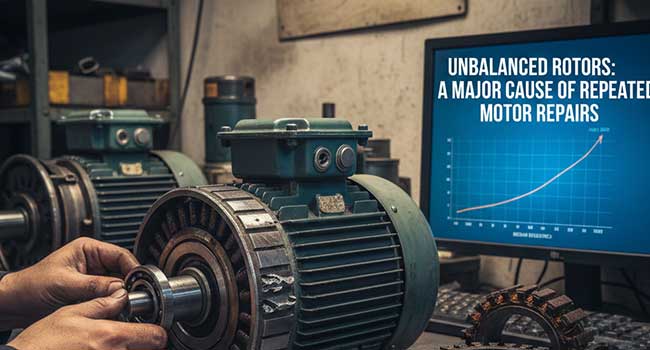
Unbalanced Rotors: A Major Cause of Repeated Motor Repairs
In industrial environments where motors operate under continuous load, repeated breakdowns are more than just a maintenance inconvenience—they are a clear signal that a deeper issue is being overlooked. As a leading provider of motor repair services in Abu Dhabi, we frequently encounter motors that return for repair again and again, despite correct rewinding, bearing replacement, and routine servicing.
In many of these cases, the root cause is neither electrical failure nor improper operation, but rotor imbalance. When imbalance goes undetected, it silently accelerates wear, shortens component life, and creates a costly cycle of repeated repairs. Understanding this hidden issue is essential for achieving long-term motor reliability and reducing unnecessary downtime.
The Hidden Reason Behind Repeated Motor Failures
Repeated motor repairs are frustrating, expensive, and disruptive—especially when the same equipment fails repeatedly despite proper servicing. Often, the real cause of these failures is mechanical rather than electrical. Rotor imbalance is one of the most commonly overlooked contributors to recurring motor problems.
When imbalance is not properly identified and corrected, it continuously stresses internal components until the motor once again ends up in the workshop. Understanding how imbalance develops and the damage it causes is key to breaking this repair cycle.
How Rotor Imbalance Develops Over Time
Rotor imbalance does not always begin as a major defect. In many cases, it develops gradually due to everyday operational and maintenance factors such as:
- Wear on rotor components
- Uneven material removal during repairs or machining
- Accumulation of dirt, dust, or corrosion
- Fan or coupling replacement
- Shaft distortion caused by overheating or mechanical stress
Even small changes in mass distribution can create significant centrifugal forces at operating speed. As the rotor spins, these forces act continuously on bearings and shafts, accelerating wear and reducing overall reliability.
The Chain Reaction of Damage Caused by Imbalance
Once rotor imbalance is present, it triggers a chain reaction of mechanical issues. The most immediate and noticeable effect is increased vibration, which spreads throughout the entire motor assembly.
Common consequences include:
- Bearing failure: Uneven loading causes bearings to overheat and wear prematurely.
- Shaft damage: Continuous bending forces can lead to shaft runout or cracking.
- Insulation breakdown: Vibration stresses stator windings and insulation, increasing the risk of electrical faults.
- Loose mechanical connections: Mounting bolts, end shields, and couplings gradually loosen over time.
While each repair may address a visible symptom—such as replacing bearings or rewinding the motor—the underlying imbalance remains uncorrected. As a result, the motor fails again, often in the same manner.
Why Standard Repairs Often Fail to Solve the Problem
Many repair processes focus on immediate and obvious faults. A failed bearing is replaced, or damaged windings are rewound. The motor is tested briefly and returned to service. However, without rotor balancing, the conditions that caused the failure remain unchanged.
This is why some motors are mistakenly considered unreliable or poorly designed. In reality, they are simply operating with an unbalanced rotor. Precision balancing is often the missing step that transforms repeated repairs into a lasting solution.
The True Cost of Ignoring Rotor Balance
The cost of repeated motor repairs extends far beyond the repair invoice. Unplanned downtime disrupts operations, maintenance teams spend valuable time addressing the same failures, and spare parts consumption increases.
Over time, imbalance-related failures can:
- Significantly shorten overall motor life
- Increase energy consumption
- Damage connected equipment such as pumps and gearboxes
- Create safety risks due to excessive vibration
Addressing rotor balance early is far more cost-effective than dealing with ongoing failures and emergency shutdowns.
How Rotor Balancing Breaks the Repair Cycle
Precision balancing equipment identifies the exact location and severity of rotor imbalance. By correcting the mass distribution, vibration levels are dramatically reduced. Bearings operate under normal load, shafts remain stable, and insulation experiences less mechanical stress.
Once properly balanced, a motor typically demonstrates:
- Extended bearing life
- Reduced vibration and operating noise
- More stable operating temperatures
- Improved long-term reliability
This shifts maintenance from a reactive approach to a preventive one—saving both time and operational costs.
When Rotor Balancing Should Be Mandatory
Rotor balancing should be considered a mandatory step in specific situations, including after:
- Motor rewinding
- Rotor machining or structural repairs
- Fan, coupling, or shaft replacement
- Repeated bearing failures with no clear electrical cause
Including balancing as a standard procedure in these cases protects the investment made in repairs and prevents future failures.
Real-World Insight
In many industrial facilities, motors with recurring failures are replaced prematurely, even though they could have operated reliably for years. In numerous cases, proper rotor balancing has eliminated vibration issues entirely and extended motor service life well beyond expectations.
This demonstrates how a relatively simple corrective process can deliver substantial long-term value.
Key Takeaway
Rotor imbalance is a major yet frequently overlooked cause of repeated motor repairs. Treating only the symptoms allows failures to continue. Precision rotor balancing addresses the root cause—reducing vibration, extending component life, and breaking the cycle of constant repairs.
For any motor with a history of recurring problems, checking and correcting rotor balance is not optional—it is a smart and necessary step toward reliable, long-term operation.