
How Diesel Engine Dyno Testing Improves Fuel Efficiency and Engine Life
Motors and generators are designed to run smoothly, quietly, and reliably. Yet in many industrial environments, unexpected failures still occur—often with little warning. Bearings fail prematurely, shafts wear faster than expected, and vibration levels increase until an emergency shutdown becomes unavoidable.
In a large number of these cases, the root cause is surprisingly simple: rotor imbalance. Rotor balancing is a maintenance practice that often goes unnoticed until a failure occurs, but when performed correctly and at the right time, it plays a critical role in preventing breakdowns and extending equipment life.
What Rotor Balancing Really Means
A rotor is considered balanced when its mass is evenly distributed around its axis of rotation. When this balance is disturbed—even slightly—the rotor generates centrifugal forces as it spins. These forces increase with speed and continuously stress bearings, shafts, couplings, and mounting structures.
The danger of rotor imbalance lies in the fact that it is not always visible. A motor or generator may continue to run and produce output, but internally, damaging forces are acting on components every second it operates.
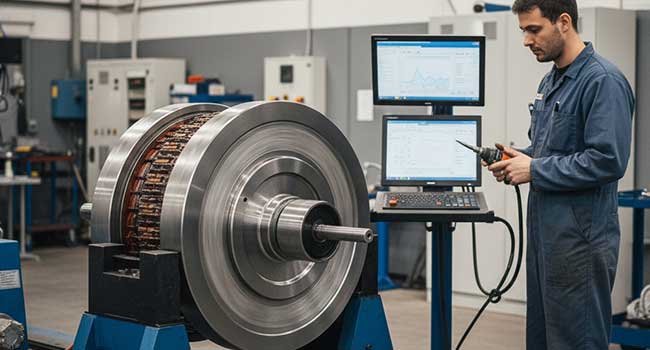
Balancing machines are designed to detect and correct these imbalances with a level of precision that cannot be achieved through visual inspection or trial-and-error methods.
Why Imbalance Leads to Motor and Generator Failures
Rotor imbalance causes vibration, and vibration is one of the most destructive forces affecting rotating equipment. Over time, this vibration leads to several common failure modes:
- Bearing damage: Bearings are often the first components to fail. Continuous vibration causes uneven loading, overheating, and accelerated wear.
- Shaft fatigue: Repeated bending forces weaken the shaft, increasing the risk of cracks or sudden breakage.
- Insulation stress: In electric motors, vibration can damage winding insulation, leading to short circuits or ground faults.
- Loose foundations and mounts: Vibration extends beyond the motor, affecting base frames, couplings, and connected equipment.
These issues rarely occur suddenly. Instead, they develop gradually, which is why imbalance is often overlooked until a major failure takes place.
How Balancing Machines Prevent Problems Before They Start
Balancing machines measure vibration levels and phase angles while the rotor is spinning. This information identifies the exact location and severity of imbalance.
Technicians can then add or remove small amounts of weight at precise points to correct the imbalance. The result is a rotor that rotates smoothly, significantly reducing stress on all connected components.
Balancing is especially important after:
- Motor rewinding
- Rotor repair or machining
- Bearing replacement
- Fan or coupling replacement
Even carefully executed repairs can alter mass distribution, making post-repair balancing essential.
Real-World Example: Generator Failure Avoided
Consider an industrial generator that has undergone rotor repair. Initially, the generator operates normally. After several weeks, bearing temperatures begin to rise, vibration increases, and eventually the generator trips on protection.
The root cause is traced to rotor imbalance introduced during the repair process. If the rotor had been balanced before reinstallation, the issue would have been identified and corrected early.
Instead, the facility experiences downtime, repair costs, and lost production—an outcome that could have been avoided with proper balancing.
Reduced Downtime and Maintenance Costs
One of the greatest advantages of rotor balancing is the reduction of unplanned downtime. Equipment that operates with minimal vibration is far less likely to fail unexpectedly.
Proper balancing also lowers maintenance costs by:
- Extending bearing and component life
- Reducing the frequency of repairs
- Preventing secondary damage to connected equipment
Over time, the cost of rotor balancing is minimal compared to the expense of repeated failures and emergency repairs.
Improved Energy Efficiency and Performance
Vibration not only damages equipment—it also wastes energy. An unbalanced rotor requires additional power to maintain operating speed, increasing energy consumption.
Balanced motors and generators run more efficiently, with smoother rotation and lower mechanical resistance. This results in stable performance and reduced operating costs, particularly for continuously operating equipment.
Why Early Detection Matters
The earlier rotor imbalance is detected, the easier and less costly it is to correct. Waiting until vibration levels become severe often means that bearings, shafts, or insulation have already been damaged.
Regular vibration analysis combined with precision rotor balancing forms a strong preventive maintenance strategy. Balancing should be viewed not as a one-time correction, but as part of responsible long-term equipment care—especially in industries where motors and generators are critical to operations.
Conclusion
Rotor imbalance is a silent but powerful cause of motor and generator failures. Excessive vibration, bearing damage, and repeated breakdowns often trace back to poor balance.
Using precision balancing machines eliminates these issues at the source, allowing equipment to operate smoothly, last longer, and perform reliably. When rotor balancing is treated as a preventive measure rather than a reactive fix, it becomes a key contributor to long-term operational stability.