Skip to content
Fuel efficiency and engine lifespan are two concerns that sit at the top of every diesel engine owner’s priority list. Whether the engine powers a generator, construction equipment, a marine vessel, or industrial machinery, poor fuel economy and early wear quickly translate into higher operating costs and unexpected downtime.
What many operators do not realize is that these problems often begin immediately after engine repair or overhauling. This is where diesel engine dyno testing plays a critical role—not just in measuring power, but in fine-tuning performance, optimizing fuel usage, and protecting long-term reliability.
Why Fuel Efficiency Often Drops After Engine Repair
After a major repair or overhaul, engine components are new or reconditioned, tolerances are reset, and systems such as fuel injection and turbocharging are recalibrated. Even minor inaccuracies during this process can result in inefficient combustion.
Common post-repair issues that negatively affect fuel efficiency include:
- Slightly incorrect fuel injection timing
- Over-fueling under load
- Uneven injector performance across cylinders
- Air-fuel imbalance caused by turbocharger or intake issues
These problems may not be noticeable during idle or light operation. The engine may start easily, run smoothly, and show no warning signs. However, once placed under sustained load, fuel consumption increases steadily. Without dyno testing, this inefficiency often goes unnoticed until fuel costs rise significantly.
How Dyno Testing Optimizes Fuel Consumption
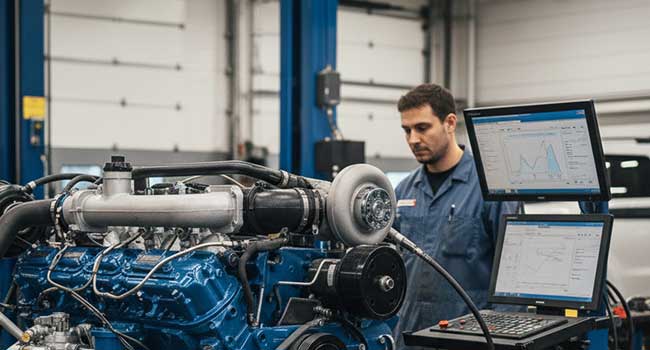
A diesel engine dynotest allows the engine to operate under controlled load conditions that closely replicate real-world use. During testing, fuel consumption is measured at multiple load levels and operating speeds, providing accurate insight into combustion efficiency.
Based on dyno data, technicians can:
- Fine-tune fuel delivery to match actual load demand
- Adjust injection timing for optimal combustion
- Balance injector output across all cylinders
- Identify and correct over-fueling or under-fueling zones
These adjustments result in cleaner combustion, allowing more energy to be extracted from every drop of fuel. Over time, even small efficiency gains produce substantial savings—especially for engines operating continuously.
The Direct Link Between Dyno Testing and Engine Life
Fuel efficiency and engine lifespan are closely linked. Inefficient combustion generates excess heat, carbon deposits, and uneven cylinder pressures. These conditions accelerate wear on critical components such as pistons, rings, valves, bearings, and turbochargers.
Dyno testing extends engine life by identifying and correcting harmful operating conditions early. By monitoring parameters such as exhaust temperature, boost pressure, vibration, and load response, technicians can detect stress points before they cause long-term damage.
For example:
- High exhaust gas temperatures under load may indicate late injection timing or restricted airflow
- Uneven power output between cylinders often points to injector imbalance
- Abnormal vibration under load can signal mechanical or combustion-related issues
Addressing these problems during dyno testing protects the engine before it is exposed to prolonged operational stress.
Preventing Carbon Build-Up and Oil Contamination
Poor combustion leads to incomplete fuel burn, resulting in carbon deposits throughout the engine. Over time, these deposits affect injector spray patterns, valve sealing, and piston movement. Fuel dilution of engine oil is another common consequence, reducing lubrication quality and increasing internal wear.
Dyno testing helps ensure clean and complete combustion across the full operating range. By optimizing air-fuel ratios and injection timing, soot formation is reduced and oil quality is preserved for longer periods.
This results in:
- Longer service intervals
- Lower maintenance costs
- Improved long-term reliability
Real-World Impact on Operational Costs
Consider a diesel generator operating continuously in an industrial facility. Even a modest improvement in fuel efficiency—such as 3 to 5 percent—can generate significant annual savings.
More importantly, an engine running efficiently experiences less thermal and mechanical stress, reducing the risk of unplanned shutdowns. Without dyno testing, higher fuel consumption is often accepted as normal after repair. With dyno testing, performance is measured, verified, and optimized.
Dyno Testing as Preventive Maintenance
Dyno testing should not be viewed only as a post-repair requirement. It also serves as an effective form of preventive maintenance. Periodic dyno testing can reveal gradual performance degradation long before it leads to failure.
This proactive approach allows operators to:
- Plan maintenance instead of reacting to breakdowns
- Maintain consistent fuel efficiency over time
- Extend engine service life without increasing downtime
Key Takeaway
Diesel engine dyno testing goes far beyond measuring power output. It plays a vital role in improving fuel efficiency and protecting engine life by ensuring proper combustion, balanced performance, and optimized operation under real load conditions.
For any diesel engine that has been repaired, overhauled, or operates under heavy demand, dyno testing is an investment that pays back through lower fuel costs, fewer failures, and longer engine life.